
woensdag 23 mei 2012
donderdag 17 mei 2012
Letters of Jane Austen

'My Aunt [Cassandra] looked them over and burnt the greater part, (as she told me), 2 or 3 years before her own death -- She left, or gave some as legacies to the Nieces -- but of those I have seen, several had portions cut out -- ' (Aunt Jane, pp. 9- 10).6
Frank's eighth daughter, Catherine Anne (who became Catherine Hubbard) saw a group of letters Jane had written to Cassandra about the trauma Jane had known when in December 1802 she accepted and then hastily rejected a proposal of marriage from the wealthy younger brother of the Bigg sisters. These Cassandra destroyed.
Fanny Austen Knight received thirty, not six letters from her aunt.
A collection of letters and other documents by (among others) Jane 's mother and father, James, Edward, Henry, Frank, Charles, Eliza and Philadelphia Walker (a first cousin to them all), and Jane Leigh-Perrot, frequently end with the command 'Burn this!' or 'Pray do not neglect burning this'.
It was not Jane but Cassandra who burnt 'the greater part' of Jane's letters, and she only committed them to the fire when in 1842 she understood her own death could not be far off.
Jane's letters to Eliza and Henry and hers to them were left in Henry's hands, and they have not survived.
However, Frank, throughout a long mobile life, carefully preserved Jane's letters to his first wife, Mary Gibson, and her packets of letters to himself and to Martha Lloyd (who became his second wife). It was Frank's youngest daughter, Fanny-Sophia, who destroyed these and she did so after her father's death (Family Record, p. 252). She acted without consulting anyone beforehand because by that time mores had changed and other of Frank's children and grandchildren would have objected.
Happily Philadelphia Walker had no direct descendents who felt their reputations or self-esteem put at risk by the existence of Eliza's letters to her, and she lived long enough so that upon her death these letters fell into the hands of someone disinterested enough to save them, though in a somewhat mutilated state.
A record of Jane Austen's great-grandmother, Elizabeth Weller Austen's steady courage, which enabled Jane's branch of the family to maintain the status of gentleman and amass wealth and prestige, survives in a seventeenth century manuscript because several generations of Austens who descended from her second oldest son, the attorney, Francis Austen of Sevenoaks, preserved it (Austen Papers, p. 2).
woensdag 16 mei 2012
the Portsmouths of Hurstbourne Park

At nearby Hurstbourne Park, residence of the Earl of Portsmouth, a very public adulterous relationship was turning the Earl into a cuckold. Jane Austen had known the Earl as a young boy when he had lived with her family at Steventon as one of George Austen's pupils. As a young woman she occasionally attended balls at Hurstbourne Park. Mrs. Austen had commented when he lived with them on the backwardness of the little boy, and as he grew up the Earl's mental condition worsened. In spite of his mental incapacity, however, he was married off in 1814 to Mary-Anne Hanson, daughter of the family lawyer. Locking up her mad husband and treating him with great cruelty (she had him whipped on a regular basis), Mary-Anne very soon brought her lover William-Rowland Alder into the house. Together they had three children. The Earl was formally declared insane only many years after Jane Austen's death. Mary-Anne was then able to marry her adulterous lover (Letters [Notes] 564-65). the free library

A magnificent, mid-18th century, walnut trestle table retaining its original gilding; from Hurstbourne Park, the former seat of the Earl of Portsmouth
dinsdag 15 mei 2012
Hackwood House, Baron Bolton, Lady Bolton (Jane Mary Powlett)

At the time Jane Austen was writing about it, the house was owned by Lord and Lady Botlon. Lady Bolton, Jane Mary Powlett, was the illegitimate daughter and eventual magnificently rich heiress of Charles Powlett, the 5th Duke of Bolton. Her husband Thomas Orde-Powlett, took her name when she inherited the estate and others from the Duke.

The Duke had failed to produce a son to inherit his title, and while the title could not be inherited by Jane due to her illegitimacy and sex, she could inherit the non entailed estates. She eventually inherited most of the Bolton estates on the death of her uncle,the 6th Duke who died without any legitimate male issue. Her husband was elevated to the peerage on 20th October 1797 by George III. He took the name of Baron Bolton of Bolton Castle in honour of his wife’s family. So I think we can assume that the latest fashions would have been worn at the virtual ducal home…

Baron Bolton
As well as spending time with the family friend Madam Lefroy, who lived at Ashe Rectory, we know that Jane and Cassandra came into contact with the infamous Boltons of Hackwood Park. (Jane dryly comments after meeting the illegitimate daughter of Lord Boltonin the Bath assembly rooms that she was ‘much improved with a wig’) dancing-years
zaterdag 12 mei 2012
Neighbours of the Austens. the Dorchesters of Kempshott Park

Kempshott House
Miss Austen, however, forged a strong connection with Kempshott in the late eighteenth and early nineteenth centuries, being a guest of Sir Guy Carleton, first Baron Dorchester (1724-1808), who succeeded the Prince of Wales as tenant of Kempshott Park in 1796 upon his retirement, remaining there until 1803.

Lord Dorchester
The balls she attended at Kempshott House were important influences on her writing. Miss Austen was even engaged briefly at one point to Harris Bigg-Wither, son of one of Kempshott's neighbouring landowners. Also acquainted with Lord Dorchester, inter alia, were the Terry family of nearby Dummer House, as was a 'tall young man named Golding', so wrote Stephen Terry, with connections to The Goldings, a private residence near Basingstoke, a possibility.
We found
Kempshott House to be a stone classical structure such as Miss Austen describes as "a modern residence." It has a large bowed centre, three windows wide, supported by a colonnade of pillars. Lord Dorchester took over Kempshott House, in the year 1796, from George, Prince of Wales, who had used it as a hunting residence. At the time of the French Revolution, a large number of émigrés of high rank were entertained at Kempshott.
Kempshot House, Adam Room (2)
(Kempshott Park Saloon - Impression)
St Louis Art Museum, Missouri, USA, 1929
On December 28, 1798, Jane wrote to Cassandra:
“Mrs. Lefroy has just sent me word that Lady Dorchester means to invite me to her Ball on the 8th of January, which tho’ an humble blessing compared with what the last page records, I do not consider as any Calamity.”
Then, the day after the ball she reports:
“There was the same kind of supper as last year, and the same want of chairs. There were more dancers than the room could conveniently hold, which is enough to constitute a good ball at any time.”
But how did she know what the supper was like in 1797 unless she had attended that ball also, perhaps along with Cassandra? In a letter of November 1, 1800, she describes a ball held on Thursday, October 30: “It was a pleasant Ball, & still more good than pleasant, for there were nearly 60 people, and sometimes we had 17 couple. The Portsmouths, Dorchesters, Boltons, Portals & Clerks were there, and all the meaner and more usual &c. &c.’s – There was a scarcity of Men in general, & a still greater scarcity of any that were good for much.”
jasna.org/persuasions
Kempshott-House
maandag 7 mei 2012
Jane Austen, professional writer
As a novelist, Jane Austen dealt in the little things that loom momentous in the everyday routines of an ordinary life: preparations for an outing, the choice of partners at a dance, the chance for intrigue in a game of cards. What we know of her life is drawn to the same miniature scale: small facts and slender insights hoarded, vetted, and handed down by a protective family who memorialized and effaced their famous aunt in equal measure. We have the six novels, all published in an intense seven-year period; some 160 letters, survivors from a much larger correspondence; and a little more than 1,100 pages of manuscript writings — apprentice pieces, experiments, and unfinished works — stretching over thirty years. Austen died aged 41 at the height of her powers. Read more of this article written by Kathryn Sutherland
jane-austen-professional-writer
zondag 6 mei 2012
Stanford’s Cottage in Warwick Street in Worthing

The house in Warwick Street where Jane Austen stayed in 1805, which still stands today, was called Stanford’s Cottage. It was a charming dwelling, whose south-facing bow windows in those days had an uninterrupted view to the sea. On the Warwick Street side there was a paved courtyard with a pair of gates and an old chestnut tree in the middle.
The north side of Warwick Street had not yet been built, nor had Ann Street, which had only recently been upgraded from a farm-track. The outlook from the north frontage of Stanford’s Cottage was therefore over fields and a few scattered buildings towards the houses on what is now North Street, with the Downs beyond. In spite of the improvements gradually taking place in Worthing during the first decade of the 19th century, Jane Austen and her party would have found the town very quiet and provincial.
Their pleasures would therefore have been simple ones, such as walks in the country and visits to the libraries, to Wicks’s warm baths on the seafront – we know that Cassandra went there on 20 September – and to grand houses in the locality.

Nonetheless, Jane Austen’s stay in Worthing clearly left a big impression on her; and when, over a decade later, in January 1817, she started writing her final novel, she set it in a small Sussex resort town she called Sanditon – which is Worthing in all but name.
Read all the story: sussex/jane-austen-worthing-connections-sanditon-sussex
vrijdag 30 maart 2012
Regency Queen Cakes for Jane Austen's Afternoon Tea Party

donderdag 22 maart 2012
Edward Knight’s Silk Suit

This silk suit- a suit of two pieces, frock coat and breeches- has been in the Knight family since the 1790s.
Edward inherited the Godmersham estate in Kent and the Chawton estate in Hampshire from Thomas Knight. He was a relative of George Austen, Edward and Jane’s father. Thomas and his wife were childless and had “adopted ” Edward, and made him their heir. This grand inheritance enabled him to provide a productive and happy home for Jane Austen her sister, Cassandra, their mother, Mrs Austen and their friend Martha Lloyd from 1809, at what is now the Jane Austen’s House Museum in the village. Austen onlyvrijdag 16 maart 2012
Miss Austen Regrets


Imogen Gay Poots[1] (born 5 June 1989) is a British actress
Miss Austen Regrets is a BBC-produced drama film. The film is based on the last few years of Jane Austen's life as she looks back on her life and loves and helps her favorite niece, Fanny, find a husband.[1
donderdag 15 maart 2012
Regency Fashion:
 In the 18th century the hand-made net was very expensive and was made of the finest thread from Antwerp: in 1790 this cost £70 per pound, sometimes more. At that time the mode of payment was decidedly primitive: the lace ground was spread out on the counter and the cottage worker covered it with shillings from the till of the shopman. As many coins as she could place on her work she took away with her as wages for her labour. It is no wonder that a Honiton lace veil before the invention of machine-made net often cost a hundred guineas. Heathcoat’s invention of a machine for making net dealt a crushing blow to the pillow-made net workers. The result is easily guessed. After suffering great depression for twenty years the art of hand-made net became nearly extinct, and when an order for a marriage veil of hand-made net was given, it was with the greatest difficulty that workers could be found to make it. The net alone for such a veil would cost £30. – A history of hand-made lace: Dealing with the origin of lace, the growth of the great lace centres, the mode of manufactures, the methods of distinguishing and the care of various kinds of lace, Emily Jackson, p. 170
janeaustensworld
donderdag 8 maart 2012
Jane Austen and Wedgwood.
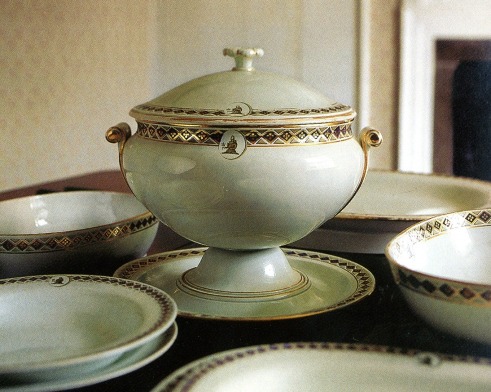
Jane Austen possessed some Wedgwood china: let’s read this extract from her letter to Cassandra Austen of the 6th June 1811:
On Monday I had the pleasure of receiving, unpacking and approving our Wedgwood ware. It all came very safely and upon the whole is a good match, tho’ I think they might have allowed us rather larger leaves, especially in such a year of fine foliage as this. One is apt to suppose that the Woods about Birmingham must be blighted.There was no bill with the Goods- but that shall not screen them from being paid. I mean to ask Martha to settle the account. It will be quite in her way for she is just now sending my Mother a Breakfast set, from the same place. I hope it will come by the Waggon tomorrow; it is certainly what we want and I long to know what it is like: and as I am sure Martha has great pleasure in making the present,I will not have any regrets.
Jane Austen and her mother were not the only fans of Wedgwood’s wares in the Austen family. Still extant at The Jane Austen House Museum is the set of Wedgwood ware that Edward Knight, Jane’s brother ordered, exactly as Jane Austen described it:
The pattern is a small Lozenge in p
mp; it is to have the (Knight) crest austenonly/jane-austen-and-london-wedgwoods
woensdag 7 maart 2012
Chawton Cottage

The dining room is at the front of the cottage. Jane sat at the window here looking out onto the road. It was the main road from London to Gosport, Winchester and Alton.She wrote at a small table positioned in the window. A large table is set with Regency tableware, for dinner. To the left of the fireplace is a cupboard in which Jane kept the families precious supply of tea.

This is a sight Jane would often see. It is the view as you come out of her bedroom to walk downstairs.

Abonneren op:
Posts (Atom)