Posts tonen met het label London. Alle posts tonen

maandag 15 september 2014

New Bond Street

Bond Street, particularly New Bond Street, was considered to be the most fashionable shopping street in London from the eighteenth century right through the Regency. But all those rooms on the floors above the shops were not just relegated to the dwellings of the shop-keepers. Bond Street was a fashionable residential address and many shop-keepers let some or all of their upper rooms to distinguished lodgers, including Dean Jonathan Swift, George Selwyn, Edward Gibbon, William Pitt the Elder, Henry Fielding, Laurence Sterne, Sir Joshua Reynolds and James Boswell, most of whom lived in Old Bond Street. Some of those who took rooms in New Bond Street include Sir Thomas Lawrence, Sir Walter Scott, Admiral Lord Nelson, and later, in a different house, Lady Emma Hamilton.

Bond Street was certainly the most fashionable shopping area of Regency London. The best dress-makers and tailors, jewellers and boot-makers, tobacconists and haberdashers all had well-appointed shops along that street. However, the overtly masculine atmosphere which prevailed along that street meant that young ladies, certainly gently-bred, unmarried ladies, must always be accompanied by a chaperon and must not be seen in public along that street anytime after mid-day. But keep in mind that mid-day in the Regency did not mean high noon, as we would assume today. Rather, young ladies would be expected to make themselves scarce by four or five o’clock in the afternoon. At that time, they should be strolling or driving through Hyde Park, or on their way home to change for dinner and their evening activities. They should most definitely not be seen strolling along Bond Street for any reason as the dinner hour approached. Mornings (in the Regency, the time between arising and dinner) on Bond Street belonged to the ladies. The remainder of the day on Bond Street belonged to the gentlemen.regencyredingote

One of the most up-market fabric shops were Wilding & Kent at Grafton house on the corner of New Bond Street and Grafton Street. On 17 April 1811 Jane and Manon, Eliza Austen’s maidservant,

‘…took our walk to Grafton House, & I have a good deal to say on that subject. I am sorry to tell you that I am getting very extravagant & spending all my Money; & what is worse for you, I have been spending yours too…’

she told Cassandra. It was a very busy shop and in November 1815 Jane complains of ‘the miseries’ of shopping there and most of her references to it mention an early start and long waits to be served – not that this stopped her going there frequently. janeaustenslondon/london-history

The streets were full of enormous coaches, sometimes gilt, hung on high springs, drawn by four, and even six horses; footmen, to the number of four or six, ran beside them, and the wheels splashed heavily in the dirt described, sending up the mud in black spurts. It was early in the nineteenth century that a new kind of paving was tried, blocks of cast-iron covered with gravel, but this was not a success. Resides the large coaches there were hackney coaches, which would seem to us almost equally clumsy and unwieldy. Omnibuses were not seen in the metropolis until 1823.

Hackney coaches were in severe competition with sedan chairs, for to call a chair was as frequent a custom as to send for a hackney coach. The chairmen were notorious for their incivility, just as the watermen had previously been, and as their successors, the cabmen, became later, though now the reproach is removed from them. These chairs were kept privately by great people, and often were very richly decorated with brocade and plush; it was not an unusual thing for the footmen or chairmen of the owner to be decoyed into a tavern while the chair was stolen for the sake of its valuable furniture. The chairs opened with a lid at the top to enable the occupant to stand up on entrance, and then were shut down; in the caricatures of the day, these lids are represented as open to admit of the lady's enormous feather being left on her head.
janeaustensworld/sedan-chairs
mollands

zondag 14 september 2014

64 Sloane Street London, House of Henry Austen


The house in Sloane Street is still there, although at first glance it is unrecognisable as the one where Jane stayed.  In 1897 another floor was added and the whole house refaced, but embedded inside is the original house, built in 1780. It is even possible to see the outer bay of the octagonal room where Eliza held a party on 25 April 1811 – all you need to do is walk a little way down Hans Street and look back at the rear of the house. In the photograph the house is covered in scaffolding and undergoing yet more changes.

There is nothing Jane would have recognised in the scene today. Sloane Street was rebuilt, or, in many cases, refaced, in the late 19th century and the inns have all either disappeared or have been replaced by Victorian buildings on the same sites. janeaustenslondon

When Jane Austen visited her brother Henry in 1811, he lived in Sloane Street (today behind Harrods in Knightsbridge). At the time, the street was a wide thoroughfare that connected Knightsbridge with the west part of Pimlico and the east end of Chelsea. The area was still quite rural, for there was no development at the east side of Sloane Street before 1790.  In the late 18th century, the approach to London from this side was still regarded as a dangerous, for the area was rural and dimly lit. Chelsea, in fact, had just recently begun to be engulfed by a burgeoning London, but during Jane Austen’s day, the area was still quite bucolic and rural, as these images attest.


By the time Henry Austen moved to Sloane Street the neighborhood had changed enough for Jane to experience pleasant society, although ten years after Jane’s death, Greenwood’s Map (1827) still showed many empty lots and gardens in the vicinity. (See map above.)
While living in Sloane Street, Henry was a successful man:
Henry and two associates had founded a banking institution in London sometime between 1804 and 1806. Austen, Maunde and Tilson of Covent Garden flourished and enabled Henry and Eliza to move from Brompton (where Jane Austen had found the quarters cramped during a visit in 1808) to a more fashionable address and larger house at 64 Sloane Street. Jane’s visits here in 1811 and 1813 were happy events, filled with parties, theatre-going, and the business of publishing Sense and Sensibility and Pride and Prejudice. – Henry Austen: Jane Austen’s “Perpetual Sunshine” by J. David Grey

 janeaustensworl

10 and 11 Henrietta Street, 1813

10 Henrietta Street is where author Jane Austen was staying (it was her brothers flat), when that she wrote most of her best letters. These letters have been published by Oxford University Press; the third edition by Deidre Le Faye who works at the British Museum. Actress, Amanda Root, unveiled a green plaque here in 1999 shadyoldlady

In 1813, Henry, who was four years older than Jane, lost his wife after a painful and debilitating illness. In contrast, his Uncle Leigh Perrot and brother Edward helped to secure his appointment as Receiver-General for Oxfordshire,  a most definite honor. Soon after Eliza’s death, Henry moved to rooms over Tilson’s bank on Henrietta Street in Covent Garden, a location more centrally located in London. Both Jane and Fanny Knight, their niece, visited him there in the spring of 1814, when Mansfield Park was with the publisher.

As was the custom, Jane brought lists of items to purchase  in Town for those who had remained behind in the countryside. In her biography, Constance Hill writes about Jane’s shopping experience:
“I hope,” she writes to her sister, “that I shall find some poplin at Layton and Shear’s that will tempt me to buy it. If I do it shall be sent to Chawton, as half will be for you; for I depend upon your being so kind as to accept it . . . It will be a great pleasure to me. Don’t say a word. I only wish you could choose it too. I shall send twenty yards.” Layton and Shear’s shop, we find, was at 11, Henrietta Street, Covent Garden. digital.library./austen/
On 24th May 1813 Jane wrote, “I went the day before (Friday) to Layton’s as I proposed, & got my Mother’s gown, 7 yds at 6/6.” [ie six shillings and six pence a yard]

“We did go to Layton & Shear’s before Breakfast. Very pretty English poplins at 4 [shillings and] 3 [pence]. Irish ditto at 6 [shillings] – more pretty certainly – beautiful.” Later in the same letter she writes to Cassandra, “…I am going to treat myself with spending [my superfluous wealth myself. I hope at least I shall find some poplin at Layton & Shears that will tempt me to buy it. If I do, it shall be sent to Chawton, as half will be for you … I shall send 20 yards.”
 janeaustensworld

No. 10 was erected in 1726 under a sixty-oneyear building lease granted to Samuel Denton of St. Paul's, Covent Garden, linen draper. The first occupant was a Mr. Bedford Loddington. (ref. 40) Between 1807 and 1816 the house was occupied by the bankers Austen, Maunde and Tilson, of whom Jane Austen's brother Henry was a partner; the novelist herself stayed here with her brother in 1813 and 1814.

The interior of No. 10 has little of interest save for the original staircase. This has two differing types of turned baluster, two to a tread, the change of type occurring at second-floor level. The bracketed step-ends are similar to those at No. 9, as is the panelling in the stair compartment. The second-floor rooms retain features of interest, the front room having its original panelling and box-cornice, and the main rear room a chimneypiece of Adam character.(ref. 41) british-history

janeaustenslondon/shopping/

Henrietta St.: Wednesday (March 9).
Well, we went to the play again last night, and as we were out a great part of the morning too, shopping, and seeing the Indian jugglers, I am very glad to be quiet now till dressing time. We are to dine at the Tilsons', and to-morrow at Mr. Spencer's.
We had not done breakfast yesterday when Mr. J. Plumptre appeared to say that he had secured a box. Henry asked him to dine here, which I fancy he was very happy to do, and so at five o'clock we four sat down to table together while the master of the house was preparing for going out himself. The "Farmer's Wife" is a musical thing in three acts, and, as Edward was steady in not staying for anything more, we were at home before ten.
Fanny and Mr. J. P. are delighted with Miss S., and her merit in singing is, I dare say, very great; that she gave me no pleasure is no reflection upon her, nor, I hope, upon myself, being what Nature made me on that article. All that I am sensible of in Miss S. is a pleasing person and no skill in acting. We had Mathews, Liston, and Emery; of course, some amusement.
Our friends were off before half-past eight this morning, and had the prospect of a heavy cold journey before them. I think they both liked their visit very much. I am sure Fanny did. Henry sees decided attachment between her and his new acquaintance.
I have a cold, too, as well as my mother and Martha. Let it be a generous emulation between us which can get rid of it first.
I wear my gauze gown to-day, long sleeves and all. I shall see how they succeed, but as yet I have no reason to suppose long sleeves are allowable. I have lowered the bosom, especially at the corners, and plaited black satin ribbon round the top. Such will be my costume of vine-leaves and paste.
Prepare for a play the very first evening, I rather think Covent Garden, to see Young in "Richard." I have answered for your little companion's being conveyed to Keppel St. immediately. I have never yet been able to get there myself, but hope I shall soon.
What cruel weather this is! and here is Lord Portsmouth married, too, to Miss Hanson.[1]
Henry has finished "Mansfield Park," and his approbation has not lessened. He found the last half of the last volume extremely interesting.
I suppose my mother recollects that she gave me no money for paying Brecknell and Twining, and my funds will not supply enough.
We are home in such good time that I can finish my letter to-night, which will be better than getting up to do it to-morrow, especially as, on account of my cold, which has been very heavy in my head this evening, I rather think of lying in bed later than usual. I would not but be well enough to go to Hertford St. on any account.
We met only Genl. Chowne to-day, who has not much to say for himself. I was ready to laugh at the remembrance of Frederick, and such a different Frederick as we chose to fancy him to the real Christopher!
Mrs. Tilson had long sleeves, too, and she assured me that they are worn in the evening by many. I was glad to hear this. She dines here, I believe, next Tuesday.
On Friday we are to be snug with only Mr. Barlowe and an evening of business. I am so pleased that the mead is brewed. Love to all. [Words omitted in Brabourne edition: "If Cassandra has filled my Bed with fleas, I am sure they must bite herself."] I have written to Mrs. Hill, and care for nobody.
Yours affectionately,
J. AUSTEN.
Miss Austen, Chawton.
By favour of Mr. Gray.
[1] His second wife. He died in 1853, and was succeeded by his brother, the father of the present earl.pemberley

donderdag 10 juli 2014

England's privately owned pleasure gardens

In the eighteenth century, England's privately owned pleasure gardens hosted royalty, nobility and famous people of the day who promenaded through exquisite, classical vistas and artfully contrived ruins in a fairyland of tinkling fountains and glittering lights. They showcased the finest musicians and artists of the day, hosting Mozart's English debut, and exhibited fine art in a public setting for the first time. At a time when the city streets were unlit and impassable (as they perceived them) except by sedan chair, pleasure gardens offered well-to-do ladies a thrilling opportunity to meet people from beyond their proscribed circle of friends. The gardens were also the first truly egalitarian venue, where anyone was granted admission for the price of a ticket, regardless of class. In an age almost as celebrity-orientated as our own, with nobles replacing TV stars, the gardens were the place to see and be seen. They began to appear as England fell in love with fun again at the Restoration, and reached their height in the 1740s and 50s. In the halcyon days of the mid to late 18th century, the gardens were the backdrop to an endless parade of concerts, balls, public breakfasts, masquerades and firework displays.

For those who worked, holidays really were only single days, and before the railways made travel to the coast or countryside viable, a day at a pleasure garden on the outskirts of the city was the perfect way to unwind. By the Victorian era most pleasure gardens had lost their Arcadian chic. Offering family entertainments, balloon ascents, animal exhibits and ice-cream, they were the forerunners of the seaside or amusement park.

Tragically, little is left of such an important part of our history. Of the great London gardens, Vauxhall Pleasure Gardens was entirely lost to Victorian property development until the blitz cleared a portion of the site, which was redefined as a park after the second world war. Now restored to the original name of Spring Gardens, it remains a public park off Kennington Lane in Lambeth, with part of the site on Tyers Street dedicated to Vauxhall City Farm and the Riding Therapy Centre. Ranelagh also all but disappeared, save for a small area where the Chelsea Flower Show is now held (Royal Hospital Road, Chelsea). The fate of the provincial gardens was generally more severe. Victims of civic and industrial expansion, almost all were gone by 1860, leaving only a district or street name to mark their passing.

On the photo: An entertainment in Vauxhall Gardens in c.1779 by Thomas Rowlandson. The two women in the centre are Georgiana, Duchess of Devonshire and her sister Lady Duncannon. The man seated at the table on the left is Samuel Johnson, with James Boswell to his left and Oliver Goldsmith to his right. To the right the actress and author Mary Darby Robinson stands next to the Prince of Wales, later George IV
--------------------------------------------------------------------------------------------------------

Sydney Gardens Vauxhall in Bath was possibly the greatest pleasure garden outside London. It boasted a labyrinth, where Jane Austen walked every day when she lived in Bath, as well as a picturesque folly of a ruined castle. Once Brunel's railway bisected the site, popularity began to wane, and by the end of the 19th century it was little more than a public park with concerts. Suffering further decline in the 20th century, there is little left apart from a bowling green and tennis courts to entertain visitors (Pulteney Road). However the space is set to return to its former glory with the current redevelopment of the Holburne Museum (bath.ac.uk/holburne) on Great Pulteney Street, once the Sydney Hotel and gateway to the gardens, and further plans to restore Sydney Gardens (Sydney Place).
• Sarah Jane Downing is the author of The English Pleasure Garden 1660-1860, published by Shire Publications, £5.99 pleasure-sydney-gardens-vauxhall-bath

On the photo: Sketch of the Fancy Fair at Sydney Gardens, Bath for the Relief of Distressed Seamen. Painted around 1836 by an unknown artist
In her letter to Cassandra dated 19th June 1799 , written while Jane Austen was staying in Bath with her brother Edward and his family in Queen’s Square, she recorded her impressions of one such event:
---------------------------------------------------------------------------------------------------------
Last night we were in Sidney Gardens (sic) again as there was a repetition of the Gala which went off so ill on the 4th-  We did not go till nine and then were in very good time for the Fire-Works which were  really beautiful and surpassing my expectations- the illuminations too were very pretty.

She appears to have disliked the music played there, for she made this caustic comment in her letter to Cassandra of the 2nd June 1799, when writing of the planned visit to the original gala:

There is to be a grand gala on Tuesday evening in Sydney Gardens-A concert with Illuminations and Fireworks; to the latter Elizabeth and I look forward with pleasure, and even the concert will have more than its usual charm with me, as the Gardens are large enough for me to get pretty well beyond the reach of its sound.

wiki/Vauxhall_Gardens

woensdag 8 januari 2014

Walking Jane Austen’s London

Walking Jane Austen’s London is a book that should be in every Janeite’s nonfiction section of their library. This book truly is as the front cover describes—a tour guide. With short and interesting anecdotes for each historical place passed (but without the rushed pace of the tour and droning voice of the guide) as well as many pictures of the Regency world then and now, Walking Jane Austen’s London captures the attention and provides a fun activity for any Austen lover.

 
23 Hans Place: Jane Austen stayed a house on this site off Sloane Street with her brother Henry in 1814-15
 
Walk 1—Sloane Street to Kensington Palace Gardens
  • The room of her brother’s home where Jane Austen did most of her letter-writing and proof reading in.
 
  • Kensington Gardens, where Elinor (from Sense and Sensibility) took a stroll–although the beauty would be somewhat marred by her companions, Mrs. Jennings and Lucy Steele!
Lady Brownlow, in her ” Reminiscences of a Septuagenarian,” tells us that after the Peace of Amiens, in 1802, she here met the celebrated Madame Recamier, who created a sensation at the West-end, partly by her beauty, but still more by her dress, which was vastly unlike the unsophisticated style and poke bonnets of the English ladies. “She appeared in Kensington Gardens à l’antique, a muslin gown clinging to her form like the folds of drapery on a statue; her hair in a plait at the back, and falling in small ringlets round her face, and greasy with huile antique; a large veil thrown over her head completed her attire, which not unnaturally caused her to be followed and stared at.” No doubt, dressed in such a costume, and at such a period, Madame Recamier might well have been the “cynosure of neighbouring eyes.” janeausten/kensington-gardens

Walk 2—Marylebone and Bond Street
  • Bond Street (present in many Regency novels), the parading ground of the dandies, beaux, and the Prince Regent.  londons-bond-streets-old-and-new
  • Wimpole Street, where Maria Rushworth (from Mansfield Park) lived before running off with Henry Crawford. wimpole-street
Walk 3—Mayfair
  • The home of Jane’s publisher, John Murray, who was (in her opinion) “…a Rogue of course, but a civil one.”
  • The residence of the fashionable and well-dressed dandy, Beau Brummell.
Walk 4—Leicester Square to Green Park


  • Almack’s Assembly was the exclusive “marriage mart” of the ton. While potential spouses for your sons and daughters could be found elsewhere, the “best” ones could ideally be found at Almack’s, where the average, everyday riffraff need not apply. Who wouldn’t want their daughter to find a wealthy, well-connected—perhaps titled—spouse to enrich the family fortunes? Matchmaking mothers everywhere yearned to have their marriageable offspring included among the exclusive company of Almack’s. regency-rites-almacks-assembly-rooms
 
  • White’s, the most exclusive of the Regency clubs and location of the famous ‘Beau’ Window, place to sit and be admired. This was also where Henry Austen was invited for a ball, along with a prince, a king, and an emperor! White's is a gentleman's club in St James's Street, London. It is the oldest and most exclusive gentleman's club in London.[1][2] It gained a reputation in the 18th century for both its exclusivity and the often raffish behaviour of its members. wiki/White's
Walk 5—Soho to the British Museum


  • The British Museum, which has Regency and Georgian exhibits, as well as a tearoom.
  • Turk’s Head coffee house, the favorite haunt of Doctor Johnson and Joshua Reynolds.
 
Read more on: london-coffee-houses.
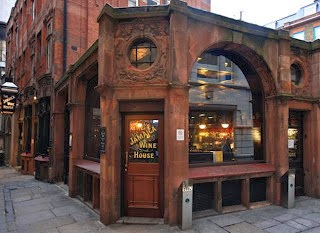
The Jamaica Wine House was originally The Turks Head, London’s first coffee house that opened between 1650 and 1652.
 
Walk 6—Westminster to Charing Cross
wiki/Poets'_Corner
  • The Poet’s Corner of Westminster Abbey, where Jane Austen has a plaque in her honor.
  • The site where Jane Austen found a portrait that “was” Jane Bingley (from Pride and Prejudice).
Walk 7—Somerset House to Lincoln’s Inn Fields

Drury Lane 1808
  • Drury Lane Theatre, the lobby where Willoughby learns of Marianne’s illness from Sir John Middleton (from Sense and Sensibility).
  •  Lincoln’s Inn (one of four historic Inns of Court), where Jane Austen’s friend and romantic interest, Tom Lefroy, returned to his legal studies after his time with relatives (and Jane).
  • lincolnsinn
Walk 8—Temple Bar to London Bridge

  • The original Twining’s teashop, where the Austen family bought their tea.

 
  • St. Clement’s Church, where Lydia and Mr. Wickham joined hands in marriage—albeit reluctantly on his part (from Pride and Prejudice).
austenprose

Wikimapia is an online collaborative mapping system that combines google maps with a wiki system, allowing users to add information. Click here to see an interactive image of a portion of London that shows Hyde Park, Mayfair, and Green Park.
map /darton1817/darton

dinsdag 27 december 2011

Jane Austen in London


This is the location of Tilson's bank, in Henrietta Street Covent Garden,where Jane Austen stayed in 1813/1814 when she visited London. Her brother Henry Austen was a partner in the bank at that time. The plaque on the wall was put there in 1999 by the Jane Austen Society and the City of Westminster.


In 1814, Henry moved from his rooms above his bank to a house he purchased in Hans Place in Knightsbridge. Today, the area, developed by Henry Holland, looks much different than when Jane and Henry knew it


In Hans Place, Jane had the use of a downstairs room that opened into the garden, and she describes her pattern of working indoors, then taking a break in the garden: “I go & refresh myself every now & then, and then come back to Solitary Coolness.”
janeaustensworld/jane-austens-visits-to-london/
-------------------

  • We hear of a small evening party to be given in Hans Place whilst Fanny is staying there with her aunt. After describing the morning engagements, Jane writes: "Then came the dinner and Mr. Haden, who brought good manners and clever conversation. From seven to eight the harp; at eight Mrs. L. and Miss E. arrived, and for the rest of the evening the drawing-room was thus arranged: on the sofa the two ladies, Henry and myself, making the best of it; on the opposite side Fanny and Mr. Haden, in two chairs (I believe, at least, they had two chairs), talking together uninterruptedly. Fancy the scene! And what is to be fancied next? Why that Mr. H. dines here again to-morrow. . . Mr. H. is reading 'Mansfield Park' for the first time, and prefers it to P. and P."
  • In the autumn of 1815 she nursed her brother Henry through a dangerous fever and slow convalescence at his house in Hans Place. He was attended by one of the Prince Regent's physicians."
  • Apropos of London shopping, Jane speaks of having some "superfluous wealth" to spend. Was it, we wonder, from the proceeds of "Sense and Sensibility"? "I hope," she writes to her sister, "that I shall find some poplin at Layton and Shear's that will tempt me to buy it. Layton and Shear's shop, we find, was at 11, Henrietta Street, Covent Garden.
  • One day Jane orders a cap for herself. "It will be white satin and lace," she writes, "and a little white flower perking out of the left ear, like Harriet Byron's feather."
  • In one of her "Letters" she speaks of going to  the Liverpool Museum and to the British Gallery. "I had some amusement at each," she writes, "though my preference for men and women always inclines me to attend more to the company than the sight."