Posts tonen met het label Houses Jane visited or lived in. Alle posts tonen

zaterdag 21 december 2024

Houses and gardens of Kent and Jane Austen's visits.


Deel vijf. Wandelen door de tuinen en landgoederen van Kent, Engeland.

Geplaatst door  op 30 april 2014


In augustus 1796 bracht Jane Austen haar eerste bezoek aan Goodnestone Park, het huis van Sir Brook Bridges, 3rd Baronet, en zijn vrouw Fanny (geboren Fowler), die de ouders waren van de vrouw van haar broer Edward, Elizabeth. Sinds hun huwelijk in 1791 woonden Edward en Elizabeth in Rowling, een landhuis op een steenworp afstand van Goodnestone Park.

vrijdag 3 juni 2022

Coastal house where Jane Austen stayed goes on the market for £1.5million.


Sea Tree House in Lyme Regis, Dorset, is that dream come true – and it has a history that want-to-be writers will love.

That history: Jane Austen stayed in the Grade II listed property in 1804, during its time as a boarding house, and its thought the iconic views over Cobb may have inspired Persuasion.

Read all: metro.uk/coastal-house-where-jane-austen-stayed-goes-on-the-market-for-1-5million

vrijdag 19 september 2014

Elizabeth Bridges (1773-1808) and Goodnestone Park


Jane Austen was often in the company of the Bridges family at their home, Goodnestone Park, in Kent, after the marriage of her brother, Edward Austen, to their daughter, Elizabeth.  genealogy/bridges In fact, that young couple spent the first years of their marriage living in Rowling House on the Goodnestone estate before inheriting Godmersham, located only a few miles away. Both Jane and Cassandra were often to be found visiting their brother and his increasing family (which eventually included eleven children) and it is no doubt here, that she first experienced some of the more socially elevated company that she would later write about. Indeed, she began First Impressions, the novel that would eventually become Pride and Prejudice, after a visit to the Goodnestone in 1796 janeausten .

Elizabeth Bridges, Edward’s wife, lived before her marriage at Goodnestone Park with her parents Sir Brook Bridges and Lady Fanny and, until they  inherited Godmersham, Edward and Elizabeth lived in a smaller house on the Goodnestone estate (Rowling House).  When Jane visited her brother, she was often entertained at Goodnestone with dinners and dances. seekingjaneausten


Portrait miniature of Elizabeth Bridges Knight wearing a white dress with a blue ribbon tied under corsage. Watercolor on ivory, oval.
2 1/2 x 2 inches (6.5 x 5 cm).
Initialed “T.H.” (lower right).
A fine portrait miniature of Jane Austen’s sister in law, Elizabeth Bridges (1773-1808) who married Edward Austen, the brother of Jane Austen. Edward took the name of his second cousin Mr. Knight on inheriting in 1812 his estates in Kent at Godmersham Park. They had 11 children.
This lot sold with an uncolored print of Godmersham Park by Watts.
Literature: Country Life. 27 July 1987, ill. p.111.  Est. $2000 – 3000.
In August of 1796, Jane Austen made her first visit to Goodnestone Park, the home of Sir Brook Bridges, 3rd Baronet, and his wife Fanny (nee Fowler), who were the parents of her brother Edward’s wife, Elizabeth. Since their marriage in 1791, Edward and Elizabeth had been living at Rowling, a manor house within a stone’s throw of Goodnestone Park. As was her habit during her long sojourns in Kent (her initial visit lasted until October of 1796), Jane wrote her sister Cassandra to report:
“We are very busy making Edward’s shirts, and I am proud to say that I am the neatest worker of the party.” Her next letter sent more glamorous news: “We were at a Ball on Saturday. We dined at
Goodnestone and in the Evening danced two Country Dances and the Boulangeries. I opened the
Ball with Edwd Bridges…We supped there, and walked home at night under the shade of two Umbrellas.” Sounds quite nice, doesn’t it?


A lot of beautiful pictures of Goodnestone Park on elizabeth-bridges-austen


 (In Dutch) Lady FitzWalter had 57 jaar op Goodnestone Park gewoond. Toen ik haar bezocht had de weduwe van de 21ste baron FitzWalter net het landhuis verruild voor een cottage in het dorp. Haar jongste zoon had voor mij de afspraak met zijn moeder geregeld. Op Google las ik dat de douairière – zoals een adellijke weduwe heet – in 1923 is geboren. Ik had dus een afspraak met een 90-jarige. Nu heb ik niks tegen hoogbejaarden – sterker nog, ik hoop er zelf ooit een te worden – maar ik zag me al met een rietje in de weer om de douairière barones van thee te voorzien. Die oer-Hollandse stroopwafels die ik voor haar mee had gebracht zou ze nooit kunnen wegkrijgen. Gelukkig blijken vooroordelen zelden te kloppen. Lady Fitzwalter was een kwieke oude dame met een scherpe blik die me al stond op te wachten bij de poort. Terwijl we naar het restaurant van Goodnestone Park Gardens wandelden vroeg ze me de hemd van het lijf. Waar was ik eerder die dag geweest? Had ik al een bezoek gebracht aan Tonbridge, waar de vader van Jane Austen opgroeide? En Godmersham, het landhuis van Janes broer Edward, was ik daar al geweest? De douairière barones, zelf een groot Austen-fan, wilde weten hoe ver mijn kennis reikte. Ze stelde me vragen over Elizabeth Bridges, over haar zus die op dezelfde dag trouwde (een dubbel huwelijk, in welk Jane Austen boek komt dat ook voor?), jane-austen-reisgids

zondag 14 september 2014

64 Sloane Street London, House of Henry Austen


The house in Sloane Street is still there, although at first glance it is unrecognisable as the one where Jane stayed.  In 1897 another floor was added and the whole house refaced, but embedded inside is the original house, built in 1780. It is even possible to see the outer bay of the octagonal room where Eliza held a party on 25 April 1811 – all you need to do is walk a little way down Hans Street and look back at the rear of the house. In the photograph the house is covered in scaffolding and undergoing yet more changes.

There is nothing Jane would have recognised in the scene today. Sloane Street was rebuilt, or, in many cases, refaced, in the late 19th century and the inns have all either disappeared or have been replaced by Victorian buildings on the same sites. janeaustenslondon

When Jane Austen visited her brother Henry in 1811, he lived in Sloane Street (today behind Harrods in Knightsbridge). At the time, the street was a wide thoroughfare that connected Knightsbridge with the west part of Pimlico and the east end of Chelsea. The area was still quite rural, for there was no development at the east side of Sloane Street before 1790.  In the late 18th century, the approach to London from this side was still regarded as a dangerous, for the area was rural and dimly lit. Chelsea, in fact, had just recently begun to be engulfed by a burgeoning London, but during Jane Austen’s day, the area was still quite bucolic and rural, as these images attest.


By the time Henry Austen moved to Sloane Street the neighborhood had changed enough for Jane to experience pleasant society, although ten years after Jane’s death, Greenwood’s Map (1827) still showed many empty lots and gardens in the vicinity. (See map above.)
While living in Sloane Street, Henry was a successful man:
Henry and two associates had founded a banking institution in London sometime between 1804 and 1806. Austen, Maunde and Tilson of Covent Garden flourished and enabled Henry and Eliza to move from Brompton (where Jane Austen had found the quarters cramped during a visit in 1808) to a more fashionable address and larger house at 64 Sloane Street. Jane’s visits here in 1811 and 1813 were happy events, filled with parties, theatre-going, and the business of publishing Sense and Sensibility and Pride and Prejudice. – Henry Austen: Jane Austen’s “Perpetual Sunshine” by J. David Grey

 janeaustensworl

10 and 11 Henrietta Street, 1813

10 Henrietta Street is where author Jane Austen was staying (it was her brothers flat), when that she wrote most of her best letters. These letters have been published by Oxford University Press; the third edition by Deidre Le Faye who works at the British Museum. Actress, Amanda Root, unveiled a green plaque here in 1999 shadyoldlady

In 1813, Henry, who was four years older than Jane, lost his wife after a painful and debilitating illness. In contrast, his Uncle Leigh Perrot and brother Edward helped to secure his appointment as Receiver-General for Oxfordshire,  a most definite honor. Soon after Eliza’s death, Henry moved to rooms over Tilson’s bank on Henrietta Street in Covent Garden, a location more centrally located in London. Both Jane and Fanny Knight, their niece, visited him there in the spring of 1814, when Mansfield Park was with the publisher.

As was the custom, Jane brought lists of items to purchase  in Town for those who had remained behind in the countryside. In her biography, Constance Hill writes about Jane’s shopping experience:
“I hope,” she writes to her sister, “that I shall find some poplin at Layton and Shear’s that will tempt me to buy it. If I do it shall be sent to Chawton, as half will be for you; for I depend upon your being so kind as to accept it . . . It will be a great pleasure to me. Don’t say a word. I only wish you could choose it too. I shall send twenty yards.” Layton and Shear’s shop, we find, was at 11, Henrietta Street, Covent Garden. digital.library./austen/
On 24th May 1813 Jane wrote, “I went the day before (Friday) to Layton’s as I proposed, & got my Mother’s gown, 7 yds at 6/6.” [ie six shillings and six pence a yard]

“We did go to Layton & Shear’s before Breakfast. Very pretty English poplins at 4 [shillings and] 3 [pence]. Irish ditto at 6 [shillings] – more pretty certainly – beautiful.” Later in the same letter she writes to Cassandra, “…I am going to treat myself with spending [my superfluous wealth myself. I hope at least I shall find some poplin at Layton & Shears that will tempt me to buy it. If I do, it shall be sent to Chawton, as half will be for you … I shall send 20 yards.”
 janeaustensworld

No. 10 was erected in 1726 under a sixty-oneyear building lease granted to Samuel Denton of St. Paul's, Covent Garden, linen draper. The first occupant was a Mr. Bedford Loddington. (ref. 40) Between 1807 and 1816 the house was occupied by the bankers Austen, Maunde and Tilson, of whom Jane Austen's brother Henry was a partner; the novelist herself stayed here with her brother in 1813 and 1814.

The interior of No. 10 has little of interest save for the original staircase. This has two differing types of turned baluster, two to a tread, the change of type occurring at second-floor level. The bracketed step-ends are similar to those at No. 9, as is the panelling in the stair compartment. The second-floor rooms retain features of interest, the front room having its original panelling and box-cornice, and the main rear room a chimneypiece of Adam character.(ref. 41) british-history

janeaustenslondon/shopping/

Henrietta St.: Wednesday (March 9).
Well, we went to the play again last night, and as we were out a great part of the morning too, shopping, and seeing the Indian jugglers, I am very glad to be quiet now till dressing time. We are to dine at the Tilsons', and to-morrow at Mr. Spencer's.
We had not done breakfast yesterday when Mr. J. Plumptre appeared to say that he had secured a box. Henry asked him to dine here, which I fancy he was very happy to do, and so at five o'clock we four sat down to table together while the master of the house was preparing for going out himself. The "Farmer's Wife" is a musical thing in three acts, and, as Edward was steady in not staying for anything more, we were at home before ten.
Fanny and Mr. J. P. are delighted with Miss S., and her merit in singing is, I dare say, very great; that she gave me no pleasure is no reflection upon her, nor, I hope, upon myself, being what Nature made me on that article. All that I am sensible of in Miss S. is a pleasing person and no skill in acting. We had Mathews, Liston, and Emery; of course, some amusement.
Our friends were off before half-past eight this morning, and had the prospect of a heavy cold journey before them. I think they both liked their visit very much. I am sure Fanny did. Henry sees decided attachment between her and his new acquaintance.
I have a cold, too, as well as my mother and Martha. Let it be a generous emulation between us which can get rid of it first.
I wear my gauze gown to-day, long sleeves and all. I shall see how they succeed, but as yet I have no reason to suppose long sleeves are allowable. I have lowered the bosom, especially at the corners, and plaited black satin ribbon round the top. Such will be my costume of vine-leaves and paste.
Prepare for a play the very first evening, I rather think Covent Garden, to see Young in "Richard." I have answered for your little companion's being conveyed to Keppel St. immediately. I have never yet been able to get there myself, but hope I shall soon.
What cruel weather this is! and here is Lord Portsmouth married, too, to Miss Hanson.[1]
Henry has finished "Mansfield Park," and his approbation has not lessened. He found the last half of the last volume extremely interesting.
I suppose my mother recollects that she gave me no money for paying Brecknell and Twining, and my funds will not supply enough.
We are home in such good time that I can finish my letter to-night, which will be better than getting up to do it to-morrow, especially as, on account of my cold, which has been very heavy in my head this evening, I rather think of lying in bed later than usual. I would not but be well enough to go to Hertford St. on any account.
We met only Genl. Chowne to-day, who has not much to say for himself. I was ready to laugh at the remembrance of Frederick, and such a different Frederick as we chose to fancy him to the real Christopher!
Mrs. Tilson had long sleeves, too, and she assured me that they are worn in the evening by many. I was glad to hear this. She dines here, I believe, next Tuesday.
On Friday we are to be snug with only Mr. Barlowe and an evening of business. I am so pleased that the mead is brewed. Love to all. [Words omitted in Brabourne edition: "If Cassandra has filled my Bed with fleas, I am sure they must bite herself."] I have written to Mrs. Hill, and care for nobody.
Yours affectionately,
J. AUSTEN.
Miss Austen, Chawton.
By favour of Mr. Gray.
[1] His second wife. He died in 1853, and was succeeded by his brother, the father of the present earl.pemberley

maandag 14 juli 2014

Mrs. Austen writes glowingly about their stay at STONELEIGH ABBEY:

In 1806, the recently widowed Mrs. Austen visited Adlestrop Rectory in Gloucestershire with her two daughters, where they stayed with her cousins Rev. Thomas Leigh and his sister Elizabeth.  During their visit,  Rev. Thomas Leigh learned that the Hon. Mary Leigh of Stoneleigh Abbey had died and that he would inherit the great house, whose origins go back to 1154. The Austen women traveled with Rev. Leigh to Warwickshire. In the following letter, Mrs. Austen writes glowingly about their stay at the mansion:

“STONELEIGH ABBEY,
“August 13, 1806. 
 “MY DEAR MARY, – The very day after I wrote you my last letter, Mr. Hill wrote his intention of being at Adlestrop with Mrs. Hill on Monday, the 4th, and his wish that Mr. Leigh and family should return with him to Stoneleigh the following day, as there was much business for the executors awaiting them at the Abbey, and he was hurried for time. All this accordingly took place, and here we found ourselves on Tuesday (that is yesterday se’nnight) eating fish, venison, and all manner of good things, in a large and noble parlour, hung round with family portraits. The house is larger than I could have supposed. We cannot find our way about it – I mean the best part; as to the offices, which were the Abbey, Mr. Leigh almost despairs of ever finding his way about them. I have proposed his setting up direction posts at the angles. I had expected to find everything about the place very fine and all that, but I had no idea of its being so beautiful. I had pictured to myself long avenues, dark rookeries, and dismal yew trees, but here are no such dismal things. The Avon runs near the house, amidst green meadows, bounded by large and beautiful woods, full of delightful walks. “At nine in the morning we say our prayers in a handsome chapel, of which the pulpit, &c. &c., is now hung with black. Then follows breakfast, consisting of chocolate, coffee, and tea, plum cake, pound cake, hot rolls, cold rolls, bread and butter, and dry toast for me. The house steward, a fine, large, respectable-looking man, orders all these matters. Mr. Leigh and Mr. Hill are busy a great part of the morning. We walk a good deal, for the woods are impenetrable to the sun, even in the middle of an August day. I do not fail to spend some part of every day in the kitchen garden, where the quantity of small fruit exceeds anything you can form an idea of. This large family, with the assistance of a great many blackbirds and thrushes, cannot prevent it from rotting on the trees. The gardens contain four acres and a half. The ponds supply excellent fish, the park excellent venison; there is great quantity of rabbits, pigeons, and all sorts of poultry. There is a delightful dairy, where is made butter, good Warwickshire cheese and cream ditto. One manservant is called the baker, and does nothing but brew and bake.
The number of casks in the strong-beer cellar is beyond imagination; those in the small-beer cellar bear no proportion, though, by the bye, the small beer might be called ale without misnomer. This is an odd sort of letter. I write just as things come into my head, a bit now and a bit then. “Now I wish to give you some idea of the inside of this vast house – first premising that there are forty-five windows in front, which is quite straight, with a flat roof, fifteen in a row. You go up a considerable flight of steps to the door, for some of the offices are underground, and enter a large hall. On the right hand is the dining-room and within that the breakfast-room, where we generally sit; and reason good, ’tis the only room besides the chapel, which looks towards the view. On the left hand of the hall is the best drawing-room and within a smaller one. These rooms are rather gloomy with brown wainscot and dark crimson furniture, so we never use them except to walk through to the old picture gallery. Behind the smaller drawing-room is the state-bedchamber – an alarming apartment, with its high, dark crimson velvet bed, just fit for an heroine. The old gallery opens into it. Behind the hall and parlours there is a passage all across the house, three staircases and two small sitting-rooms. There are twenty-six bedchambers in the new part of the house and a great many, some very good ones, in the old. There is also another gallery, fitted up with modern prints on a buff paper, and a large billiard-room. Every part of the house and offices is kept so clean, that were you to cut your finger I do not think you could find a cobweb to wrap it up in. I need not have written this long letter, for I have a presentiment that if these good people live until next year you will see it all with your own eyes. “Our visit has been a most pleasant one. We all seem in good humour, disposed to be pleased and endeavouring to be agreeable, and I hope we succeed. Poor Lady Saye and Sele, to be sure, is rather tormenting, though sometimes amusing, and affords Jane many a good laugh, but she fatigues me sadly on the whole. To-morrow we depart. We have seen the remains of Kenilworth, which afforded us much entertainment, and I expect still more from the sight of Warwick Castle, which we are going to see to-day. The Hills are gone, and my cousin, George Cook, is come. A Mr. Holt Leigh was here yesterday and gave us all franks. He is member for, and lives at, Wigan in Lancashire, and is a great friend of young Mr. Leigh’s, and I believe a distant cousin. He is a single man on the wrong side of forty, chatty and well-bred and has a large estate. There are so many legacies to pay and so many demands that I do not think Mr. Leigh will find that he has more money than he knows what to do with this year, whatever he may do next. The funeral expenses, proving the will, and putting the servants in both houses in mourning must come to a considerable sum; there were eighteen men servants.” – Letter, Hill, Jane Austen: Her Homes and Her Friends
stoneleigh-abbey 

zaterdag 12 juli 2014

Godmersham Park and Tonbridge


Godmersham was inherited by Jane's brother Edward from the childless Knights. Jane and Cassandra were frequent visitors to both houses, and Jane worked on several of her novels while staying at Godmersham. She drew on her experiences in Kent for her descriptions of her fictional grand houses. When the Reverend George Austen died, Edward offered a choice of houses to his mother and sisters. One was in Wye, and the other was Chawton Cottage.   

Tonbridge


The Austen family originated in the Horsmonden area, and the Reverend George Austen was born in Tonbridge, attended Tonbridge School, and returned for a time as a master.


The Upper School at Tonbridge School, where George Austen taught tonbridgehistory

His widowed and penniless grandmother, Elizabeth Weller, showed great resourcefulness in taking up a place as a matron and housekeeper at Sevenoaks School to ensure that all her sons received a good education.


Jane's brother Edward was adopted by the Knight family as a child and grew up on Godmersham Park Estate. He inherited Godmersham Park and with his wife Elizabeth, made it his family home. Jane was a frequent visitor to Edward's home and the inspirational surroundings and social environment it had to offer. She was particularly fond of Edward and Elizabeth's eldest daughter, her much loved niece Fanny with whom she exchanged intimate correspondence. Copies of some of Jane's letters to Fanny are on display at The Godmersham Park Heritage Centre, along with other interesting treasures which have been collected and conserved for the Parishes of Godmersham and Crundale, which the Centre has been established to serve. (Visits to the Heritage Centre can be made by arrangement with the Administrator as follows: Rebecca Lilley tel: 01227 732272
Email:
heritagecentre@btconnect.com) 

Some of Jane’s letters written from Godmersham give the flavour of the place as it was in those days:


""We live in the Library except at Meals & have a fire every Eveng … I am now alone in the Library, Mistress of all I survey – at least I may say so & repeat the whole poem if I like it, without offence to anybody … At this present time I have five Tables, Eight and twenty chairs & two fires all to myself … Yesterday passed quite à la Godmersham … James and Mary are much struck with the beauty of the place … The Comfort of the Billiard Table here is very great. – It draws all the Gentlemen to it whenever they are within, especially after Dinner, so that my Br Fanny & I have the Library to ourselves in delightful quiet … Half an hour before breakfast – (very snug, in my own room, lovely morng, excellent fire, fancy me) … In another week I shall be at home – & then, my having been at Godmersham will seem like a Dream … But in the meantime for Elegance & Ease & Luxury.” jasna.

tonbridgehistory
---------------------------------------------------------------------------------


Edward (1767-1852) was was adopted in the early 1780′s by rich childless cousins of the Austens, Thomas and Catherine Knight. He was sent by them on the “grand tour” of continental Europe in 1786-1788, and eventually inherited their estate of Godmersham, Kent, and took the last name of “Knight”. In 1791, he married Elizabeth Bridges. Two years later the couple welcomed their first child, Fanny. Unfortunately for the happy couple, Elizabeth died when Fanny was not yet sixteen (shortly after her 11th confinement). Fanny’s aunts, Cassandra and Jane, who had once been occasional visitors, now took on a much more involved and motherly role in the lives of their nieces and nephews. Cassandra, especially, spent months at a time at the family estate, Godmersham, tending to the needs of her young charges, while her brother grieved the loss of his wife.
For Jane, the plight of young Fanny was especially worrisome, as she considered her new role in the family:

Soon after his wife’s death, Edward inherited a house and property in Chawton and was able to offer the nearby cottage to his mother and sisters. This close proximity to the family they loved so much must have only deepend the intimacy of the two. fanny-austen-knight-knatchbull

vrijdag 4 juli 2014

Home of Jane Austen and her family during their stay, 4 Sydneystreet Bath.

For the Austens the first floor was the most important. Here they received their quests and were living a great part of the day. The view through the three windows is pretty much the same as Jane saw.


The first floor is bought in 2011 by Bath Boutique Stays.   They restored it in a beautiful way.  bath-boutique-stays

dinsdag 1 juli 2014

The Dean Gate Inn

The Dean Gate Inn is an old coaching inn and postal receiving house.


The position of the Steventon Rectory is marked by the arrow marked with number “3″ and the position of the Ashe Rectory, home of Jane Austen’s great friend, Mrs Lefroy, is marked by the arrow numbered “2″. Jane Austen mentions Dean Gate in her letter to Cassandra Austen, her sister, written on the 9th January 1796: We left Warren at Dean Gate in our way home last night and he is now on his road to town. Warren, was John Willing Warren (1771-1831) who was one of the Reverend George Austen’s pupils at Steventon Rectory. He was a life long friend of the Austens and Deirdre le Faye describes him in her book,

Jane Austen: A Family Record as follows:
When Jane and Cassandra returned home from school in the autumn of 1786 their daily companions were therefore…the good natured, ugly John Willing Warren, son of Mr Peter Warren of Mildred Court, Cornhill, London who had come some time in the 1780s and who also went up to Oxford in 1786 ,remained a friend for life and is mentioned in several of Jane’s letters.

So, as a place to catch and be dropped off by coaches,  this inn would have been a very familiar place for the Austens, travelling to family, university, and naval college. Their pupils, friends and family would have used it on the way to and from Steventon, and no doubt the Austens used it too. Jane Austen almost certainly used it when she travelled to Andover to meet with Mrs Poore and her mother, the wife of Phillip Henry Poore, the apothecary, surgeon and man-midwife, while changing coaches on the way to visit Martha Lloyd at Ibthrope:

My Journey was safe and not unpleasant. I spent an hour at Andover of which Messrs Painter and Redding had the larger part; twenty minutes however fell to the lot of Mrs Poore and her mother, whom I was glad to see in good looks and spirits.
(See Letter to Cassandra Austen dated 30th November 1800)

Constance Hill in her book, Jane Austen Her Homes and her Friends, published in 1923, describes her joy at being able to stay at the Dean Gate Inn on her first excursion into what she termed “Austenland”:

After a short halt we again resumed our journey, and finally, as darkness was closing in, we drew up triumphantly at the solitary inn of Clarken Green. But our triumph was of short duration. Within doors all was confusion – rooms dismantled, packing-cases choking up the entries, and furniture piled up against the walls. The innkeeper and his family, we found, were on the eve of a departure. It was impossible, he said, to receive us, but he offered us the use of a chaise and a fresh horse to take us on to Deane – a place a few miles farther west – where he thought it possible we might find shelter in a small inn. The name struck our ears, for Deane has its associations with the Austen family. There Jane’s father and mother spent the first seven years of their married life. By all means let us go to Deane! So bidding farewell to our charioteer, the blacksmith’s wife, as she led her sturdy pony into the stable, we drove off cheerily along the  darkening roads. Before long a light appeared between the trees, and in a few minutes we were stopping in front of a low, rambling, whitewashed building – the small wayside inn of Deane Gate. Our troubles were now over, and much we enjoyed our cosy supper, which we ate in a tiny parlour of spotless cleanliness. A chat with our landlady gave us the welcome intelligence that we were within two miles of Steventon. Our small tavern and Gatehouse (as it was formerly) stood, she said, where the lane for Steventon joins the main road to the west. This, no doubt, would give it importance for the Austens and their country neighbours; and we recalled the words of Jane in one of her letters, when speaking of a drive from Basingstoke to Steventon she says: “We left Warren at Dean Gate on our way home.” So we fell asleep that night with the happy consciousness that we were really in Austen-land. austenonly


woensdag 8 januari 2014

Walking Jane Austen’s London

Walking Jane Austen’s London is a book that should be in every Janeite’s nonfiction section of their library. This book truly is as the front cover describes—a tour guide. With short and interesting anecdotes for each historical place passed (but without the rushed pace of the tour and droning voice of the guide) as well as many pictures of the Regency world then and now, Walking Jane Austen’s London captures the attention and provides a fun activity for any Austen lover.

 
23 Hans Place: Jane Austen stayed a house on this site off Sloane Street with her brother Henry in 1814-15
 
Walk 1—Sloane Street to Kensington Palace Gardens
  • The room of her brother’s home where Jane Austen did most of her letter-writing and proof reading in.
 
  • Kensington Gardens, where Elinor (from Sense and Sensibility) took a stroll–although the beauty would be somewhat marred by her companions, Mrs. Jennings and Lucy Steele!
Lady Brownlow, in her ” Reminiscences of a Septuagenarian,” tells us that after the Peace of Amiens, in 1802, she here met the celebrated Madame Recamier, who created a sensation at the West-end, partly by her beauty, but still more by her dress, which was vastly unlike the unsophisticated style and poke bonnets of the English ladies. “She appeared in Kensington Gardens à l’antique, a muslin gown clinging to her form like the folds of drapery on a statue; her hair in a plait at the back, and falling in small ringlets round her face, and greasy with huile antique; a large veil thrown over her head completed her attire, which not unnaturally caused her to be followed and stared at.” No doubt, dressed in such a costume, and at such a period, Madame Recamier might well have been the “cynosure of neighbouring eyes.” janeausten/kensington-gardens

Walk 2—Marylebone and Bond Street
  • Bond Street (present in many Regency novels), the parading ground of the dandies, beaux, and the Prince Regent.  londons-bond-streets-old-and-new
  • Wimpole Street, where Maria Rushworth (from Mansfield Park) lived before running off with Henry Crawford. wimpole-street
Walk 3—Mayfair
  • The home of Jane’s publisher, John Murray, who was (in her opinion) “…a Rogue of course, but a civil one.”
  • The residence of the fashionable and well-dressed dandy, Beau Brummell.
Walk 4—Leicester Square to Green Park


  • Almack’s Assembly was the exclusive “marriage mart” of the ton. While potential spouses for your sons and daughters could be found elsewhere, the “best” ones could ideally be found at Almack’s, where the average, everyday riffraff need not apply. Who wouldn’t want their daughter to find a wealthy, well-connected—perhaps titled—spouse to enrich the family fortunes? Matchmaking mothers everywhere yearned to have their marriageable offspring included among the exclusive company of Almack’s. regency-rites-almacks-assembly-rooms
 
  • White’s, the most exclusive of the Regency clubs and location of the famous ‘Beau’ Window, place to sit and be admired. This was also where Henry Austen was invited for a ball, along with a prince, a king, and an emperor! White's is a gentleman's club in St James's Street, London. It is the oldest and most exclusive gentleman's club in London.[1][2] It gained a reputation in the 18th century for both its exclusivity and the often raffish behaviour of its members. wiki/White's
Walk 5—Soho to the British Museum


  • The British Museum, which has Regency and Georgian exhibits, as well as a tearoom.
  • Turk’s Head coffee house, the favorite haunt of Doctor Johnson and Joshua Reynolds.
 
Read more on: london-coffee-houses.
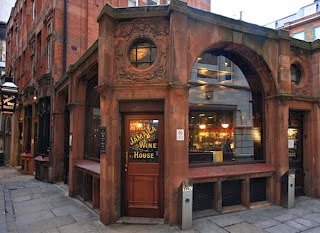
The Jamaica Wine House was originally The Turks Head, London’s first coffee house that opened between 1650 and 1652.
 
Walk 6—Westminster to Charing Cross
wiki/Poets'_Corner
  • The Poet’s Corner of Westminster Abbey, where Jane Austen has a plaque in her honor.
  • The site where Jane Austen found a portrait that “was” Jane Bingley (from Pride and Prejudice).
Walk 7—Somerset House to Lincoln’s Inn Fields

Drury Lane 1808
  • Drury Lane Theatre, the lobby where Willoughby learns of Marianne’s illness from Sir John Middleton (from Sense and Sensibility).
  •  Lincoln’s Inn (one of four historic Inns of Court), where Jane Austen’s friend and romantic interest, Tom Lefroy, returned to his legal studies after his time with relatives (and Jane).
  • lincolnsinn
Walk 8—Temple Bar to London Bridge

  • The original Twining’s teashop, where the Austen family bought their tea.

 
  • St. Clement’s Church, where Lydia and Mr. Wickham joined hands in marriage—albeit reluctantly on his part (from Pride and Prejudice).
austenprose

Wikimapia is an online collaborative mapping system that combines google maps with a wiki system, allowing users to add information. Click here to see an interactive image of a portion of London that shows Hyde Park, Mayfair, and Green Park.
map /darton1817/darton

zaterdag 28 juli 2012

Jane Austen stayed in Lyme with her family in the summer of 1804 and used her impressions of the beautiful little seaside town as background for her novel Persuasion


Pyne House, Lyme Regis, where Jane Austen was thought to have stayed.


THE COBB


Since Jane visited in 1803 there have been alterations to the Cobb and the steps may have been different. 
 

In Persuasion there is a denouement at the point that Lousia Musgrove falls and cracks her head on the Cobb…….


“There was too much wind to make the high part of the new Cobb pleasant for the ladies, and they agreed to get down the steps to the lower, and all were contented to pass quietly and carefully down the steep flight, excepting Louisa; she must be jumped down them by Captain Wentworth. In all their walks, he had had to jump her from the stiles; the sensation was delightful to her. The hardness of the pavement for her feet, made him less willing upon the present occasion; he did it however; she was safely down, and instantly, to shew her enjoyment, ran up the steps to be jumped down again. He advised her against it, thought the jar too great; but no, he reasoned and talked in vain; she smiled and said, “I am determined I will”: he put out his hands; she was too precipitate by half a second, she fell on the pavement on the Lower Cobb, and was taken up lifeless!” 
360panoramas/cobb

zaterdag 4 februari 2012

Godmersham Park


Godmersham Park Design Sponge

Jane's brothers and sisters were all going their own way, into the navy, into marriage. Her brother Edward had been adopted by the wealthy Knight family and had become a landed gentlemen in Kent. He lived at the family seat in Godmersham, and Jane would often visit to help with Edward's rapidly expanding family. Jane probably had Godmersham Park in mind when she was creating the Darcy estate of Pemberley in Pride and Prejudice. On her first visit to Pemberley Elizabeth Bennett thought to herself: "To be mistress of Pemberley might be something." Jane must have thought the same looking at Godmersham, a place where she was often treated as the poor relation. Godmersham Park can still be seen in the village of Godmersham, just off the A28 between Ashford and Canterbury, Kent. Godmersham is privately owned and is not set up for visitors. However, you can see the front of the house, and there is a walk from the estate's main gate, through the park down towards the river Stour.
 http://www.infobritain.co.uk/jane_austen.htm


Viewed from the old bridge over the Stour.

Godmersham Park and Mansion has a famous literary connection. Jane Austen spent time in the mansion between 1794 and 1813 and possibly based Persuasion and Mansfield Park on her experiences of local Kentish society.